Podcast
Philosophize This!
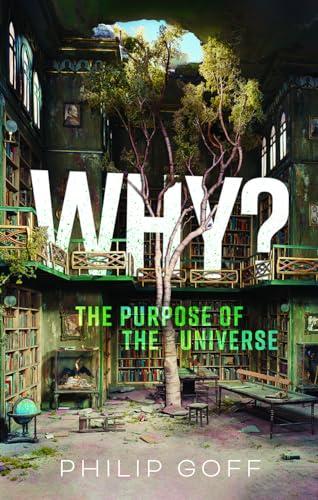
Philip Goff's book "Why?" delves into the possibility of a cosmic purpose without relying on a supernatural deity. He argues that the fine-tuning of physical constants in the universe points towards a teleological law that selects for chemical complexity, rationality, and value.
And on that note we also promise to talk about the new book from the philosopher Philip Goff on this episode and we will we'll use it in this investigation of different ideologies.
— Episode: Episode #197 ... New Atheists and cosmic...
Episode: Episode #197 ... New Atheists and cosmic purpose w...
Philip Goff's book "Why?" delves into the possibility of a cosmic purpose without relying on a supernatural deity. He argues that the fine-tuning of physical constants in the universe points towards a teleological law that selects for chemical complexity, rationality, and value.
And on that note we also promise to talk about the new book from the philosopher Philip Goff on this episode and we will we'll use it in this investigation of different ideologies.
But I guess it's important to say this in that book we're going to talk about a little later Philip Goff is building off of the work of a philosopher named Thomas Nagle.
as Philip Goff says over the years you can see this attitude start to crop up in different places Nietzsche famously declaring God is dead Mark saying that religions the opiate of the masses Freud saying that a belief in God is ultimately a longing for daddy and what all this leads to is a more common ideological attitude amongst people living at the beginning of the 20th century that science is the way that we arrive at the truth and that anything that isn't understandable by studying the materials that something's made out of is likely to be religious nonsense and what this leads to is an overall skepticism in people of non-material explanations for things overall hence the views on consciousness where no matter how non material it may seem it's got to be in the brain somewhere hidden from us we just need more time or with hard determinism no matter how much it seems like we make free choices gotta ultimately be predictable with the atoms in the prior events in some way or that morality is at best something that's completely subjective already about it forever and at worst it's a total delusion purely relative just monkeys rattling their cage these positions are logical conclusions if you're starting from the ideology of material reductionism as well as the conclusions that life is completely meaningless that it's obvious we live in a totally disinterested absurd universe and that nothing really matters that's a hallmark of the times as well
but I want to paint a picture of a what if scenario that Thomas Nagel and Philip Goff would want us to consider philosophize this everybody I believe I ever used to do that what if in 500 years people look back on the time we're living in right now and they see the ways that we were thinking about science and materialism and they say look I think I get it I think I get where they were coming from these people knew their religious history they knew how they used to project meanings onto things that were fake they didn't want to do that again these people saw the miracles of science going on all around them you know they were living in the wake of some of the greatest scientific discoveries the world had ever seen at the time they had mad respect for science but because they were living in this precise historical moment because it was understandable to commit yourself to materialism in this extreme of a way these people ignored the obvious purpose in order to the universe that was staring them in the face the whole time that anybody 500 years before or after just assumes is obvious as one of those necessary philosophical assumptions we have to smuggle in to be capable of doing good science something on the level of induction or rational coherence
the title of philip goff's new book retries to explore some answers to this is called why the purpose of the universe and before we talk about how purpose in the universe may make sense without there being some sort of supernatural man with a staff i want to follow up on that what if scenario that we gave before if we are living in a particular moment in history where we're obsessed with materialism in more ways than one then that must mean that there's evidence that the universe has a purpose all around me and I'm just either not seeing it or I'm reframing it through my own biases in a way where I just can't see it where is that evidence if it's there
a universe where there is life in all its richness including people who can fall in love experience great beauty and contemplate their own existence and quote
it's not that I can't see how this could be possible what I'm saying is in my world extraordinary claims require extraordinary evidence
but again look part of the way we model our understanding of the world around us in the sciences and otherwise is by using probabilities and just given the evidence we have now filter through a very standard Bayesian probability equation that we use to model a lot of other ways we see reality to Philip Gough it is just far more likely that the value selection hypothesis is true or that it's far less likely that it's false
scientists in the 16th century struggle to accept the mounting evidence that the earth was not contrary to what had been assumed for thousands of years in the center of the universe popular science discussion often involves scoffing at this inability of our ancestors to follow the evidence where it leads but every generation absorbs a worldview that it can't see beyond in our own time we're so used to the idea that science has done away with cosmic purpose that we're incapable of dispassionately considering the overwhelming evidence that's emerged in support of the value selection hypothesis it may take time for the culture to catch up with the evidence and quote
Gossess quote what Nagel had realized is that there's no incoherence in the idea of cosmic purpose without god provided we can expand our conception of the laws that govern the universe the laws of nature we've been used to for the past 500 years move from past to future ensuring that what happens at earlier times determines what happens at later times Nagel's proposal is that there may also be laws that move from future to past ensuring that the present is shaped by the need to get closer to certain goals in the future such as the emergence of life in other words there may be laws of nature with goals built into them and we call these teleological laws end quote
the book is a fun interesting exploration of a resolution between some common disagreements and the hope from Philip Goff is that this book can help the conversation move forward in a productive way it's called why the purpose of the universe now that's set hopefully this was all very thought provoking today not just when it comes to the details of the scientific theoretical model and our responsibility there if we want to have better and better conversations but also when it comes to the role of ideology and all this if you're Slavaj Giezek I just pictures Giezek waiting for the ideas we're going to talk about next episode I see him sitting on the sidelines in a field and a soccer game you know sitting on one of those fold out chairs eating a hot dog it's watching this game being played that we're talking about on this episode clapping at what he's seeing like he's some kind of Roman Emperor just waiting ready to pounce ready to get us thinking about the real game he thinks we're all playing thanks for sharing the podcast with a friend if it's something you enjoy patreon shout outs this week cat Clark Stanford De Silva James Trab sir you Philippe and yesterday's rice that's both someone's name and you know I just like to thank rice in general really has developed into a fine respectable carbohydrate option thank you for listening i'll talk to you next time