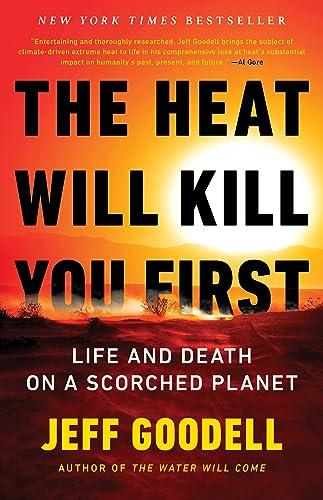
The Heat Will Kill You First: Life and Death on a Scorched Planet Cover
Podcast Mentions

The Heat Will Kill You First Life and Death on a Scorched Planet

Jeff Goodell

New York Times

Podcasts 3
Quotes 15
99% Invisible

Jeff Goodell, the author, became interested in the dangers of heat after a personal experience walking through downtown Phoenix in the summer. He wrote the book to explore the physiological impact of climate change.

"

I had been covering climate change for 20 years and didn't give heat much thought, as strange as that may seem.

— Episode: Not Built For This #6: Maximum Temperatu...

Episode: Not Built For This #6: Maximum Temperature

Jeff Goodell, the author, became interested in the dangers of heat after a personal experience walking through downtown Phoenix in the summer. He wrote the book to explore the physiological impact of climate change.

"

I had been covering climate change for 20 years and didn't give heat much thought, as strange as that may seem.

It was like walking into a kind of solid wall of this invisible force that just surrounds you and envelops you and kind of suffocates you and makes your body, I mean the only word I can use to kind of describe it is freak out.

And I realized, oh my gosh, heat is dangerous.

We've become dependent upon this machine, this cooling machine.

Starts to kind of panic and think, OK, I need to cool off. We're not cooling off fast enough. I need to push more blood and more blood.


Morning Joe

The book was said to be timely given the current heat wave and the author spoke about climate change and the need to be educated and make better choices about it. The paperback edition was released on July 9th.

"

The Heat Will Kill You First, Life and Death on a Scorched Planet is out in paperback on July 9th, and it is worth reading given what we are enduring right now.

— Episode: Morning Joe 6/20/24

Episode: Morning Joe 6/20/24

The book was said to be timely given the current heat wave and the author spoke about climate change and the need to be educated and make better choices about it. The paperback edition was released on July 9th.

"

The Heat Will Kill You First, Life and Death on a Scorched Planet is out in paperback on July 9th, and it is worth reading given what we are enduring right now.

Well, what's going on is we're living in the age of climate chaos. We've known for 100 years that burning fossil fuels puts more CO2 into the atmosphere, more CO2 in the atmosphere is creating a hotter climate, and we're seeing that now.

Our world was built for a climate that no longer exists.

I think there's a lot of people who think that climate change is like a broken leg, that we just need to drive electric cars and recycle our bottles and do that for a little while, and then everything will be OK and we'll go back to the world that we lived in in the earlier part of the 20th century. Things will go back to normal. Things are not going to go back to normal.

We are moving into a completely different climate era, and the implications for that are profound. The way that our cities are arranged and built do not work in an era of extreme warming. Where we get our water supply does not work in a world of extreme warming.

All In with Chris Hayes

Goodell highlighted the severity of heat waves, specifically in India, emphasizing that heat is a silent killer that can quickly lead to near-death conditions. He also mentioned the urgent need for a reinvention of cities to combat the urban heat island effect, proposing a more sustainable design with increased shade, green spaces, and access to cooling.

"

I've talked about extreme heat as being like a bug zapper. I mean, within a few hours in these kinds of conditions, you can go from feeling fine to near death.

— Episode: Bernie shreds billionaires backing Trump...

Episode: Bernie shreds billionaires backing Trump: 'They'd...

Goodell highlighted the severity of heat waves, specifically in India, emphasizing that heat is a silent killer that can quickly lead to near-death conditions. He also mentioned the urgent need for a reinvention of cities to combat the urban heat island effect, proposing a more sustainable design with increased shade, green spaces, and access to cooling.

"

I've talked about extreme heat as being like a bug zapper. I mean, within a few hours in these kinds of conditions, you can go from feeling fine to near death.

Well, I mean, the kind of infrastructure we need, to be honest, is like a reinvention of what a city looks like. You know, our cities are built of asphalt and concrete and steel. They amplify heat. Their heat sinks. There's a scientific term called urban heat island effect.

A lot of people think, oh, it's hot. We just need to get more people air conditioning. Well, it's not that simple. You know, first of all, 75 million people on the planet don't even have access to electricity, much less air conditioning.

You know, 10 years ago I used to be in debates with fossil fuel CEOs and they would say, oh, we can't go to renewables. You can't build solar. We can't build wind because it's too expensive.

Well, it's the exact opposite now, right? If you want to build if you want to get cheap energy to people, the way you do it is by building solar and wind.

Note: The book recommendations on this page are discovered automatically from podcast transcripts, and may be incorrect or incomplete.