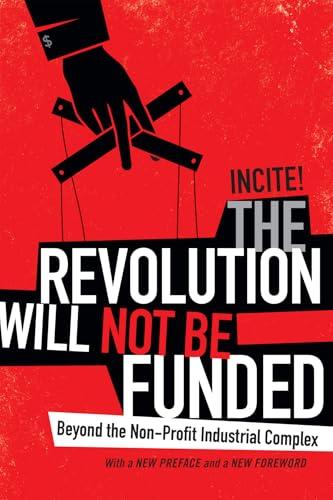
The book examines the negative impact of the non-profit industrial complex. It criticizes how large amounts of money are used by wealthy patrons to control or co-opt social movements and stifle real change.
The nonprofit industrial complex popularized by a book called the revolution will not be funded this idea that because the nonprofit industry is so lucrative like we discussed before over 2.6 trillion...
— Episode: Mini Show #36: Progressive Wins, GOP Shi...
Episode: Mini Show #36: Progressive Wins, GOP Shift, Al Jaz...
The book examines the negative impact of the non-profit industrial complex. It criticizes how large amounts of money are used by wealthy patrons to control or co-opt social movements and stifle real change.
The nonprofit industrial complex popularized by a book called the revolution will not be funded this idea that because the nonprofit industry is so lucrative like we discussed before over 2.6 trillion dollars in annual revenue there will undoubtedly be as one scholar defined it quote a set of symbiotic relationships that link political and financial technologies of state and owning class control with surveillance over public political ideology including an especially emergent progressive and leftist social movements
Episode: Mini Show #36: Progressive Wins, GOP Shift, Al Jaz...
This book explores the idea of the "nonprofit industrial complex," which is a set of symbiotic relationships that link political and financial technologies of state and owning class control with surveillance over public political ideology.
The idea of the nonprofit industrial complex popularized by a book called the revolution will not be funded this idea that because the nonprofit industry is so lucrative like we discussed before over 2.6 trillion dollars in annual revenue there will undoubtedly be as one scholar defined it quote a set of symbiotic relationships that link political and financial technologies of state and owning class control with surveillance over public political ideology including an especially emergent progressive and leftist social movements to put it in simple terms the nonprofit sector can and will be used by wealthy powerful interests to surveil and even co-op nascent social movements that threaten their wealth and power so the nonprofit industrial complex does not exist to create fundamental change but rather exist to protect its own status and that of its patrons which makes it possible for the ruling class to not only contain a revolution but to shut it down altogether for example in the case of black lives matter despite huge amounts of grassroots support and engagement nearly every corporation in america was able to to co-op the BLM slogan without most of them enacting any kind of fundamental changes to their business practices even in cases where said corporations employed an exploited disproportionately black and brown workforce i'm looking at you amazon when BLM first published their website back in 2015 the co-founders described themselves as quote train marxists but by 2021 they were doing zoom events sponsored by global capitalist boot brand ug so looking at the story of the BLM global network foundation it's hard not to assume some significant character flaws of its leaders but it's also not hard to imagine that all the money and attention from corporate interests did have some effect on their tactics as well philosopher mary herrington wrote recently in unheard magazine quote people in glass houses are famously advised not to throw stones and as the progressive worldview has become more monolithically elite in class terms it's also lost its antagonism to big business this is just an observation my observation but i think the in the streets activist leaders of the 1960s civil rights movement look very different from the champagne sipping activist leaders of the modern BLM era civil rights movement right just something i read recently just in handsford a Howard university professor joke that having an organization called the black lives matter global foundation would be akin to having a group in the 1960s call themselves civil rights ink essentially everything today has been corporatized the the activists movements used to be so much more skeptical of the nonprofit sector because of its obvious ties to money and power but that distress has seemed to all but disappear quote another example is plan parenthood's action fund which reinforces and perpetuates the idea that the solution to large-scale political problems is donating to an organization that then hires a lobbyist as opposed to say building a mass movement capable of occupying congress or otherwise disrupting business as usual until its demands are met we seem to have adopted a kind of leave it up to experts mentality there's there's a nonprofit today for basically every cause BLM plan parenthood or the many ukraine relief funds that have recently popped up and for the most part we just kind of assume that they all know what they're doing and have the best interests of those they claim to serve in mind so for most socially conscious folks who want to feel like they are contributing positively to society but are also busy living their own lives the logical conclusion is to just give money to a nonprofit and let them handle it but the question is can the interest of the nonprofit industrial complex with its ties to mega foundations funded by corporations in the ultra wealthy actually align to the interests of the people who they claim to serve because one has to wonder are these wealthy powerful people setting up these foundations for purely altruistic or humanitarian reasons or do these foundations serve ulterior purposes such as protecting the reputations and projecting the power of the people who run them and perhaps no other foundation raises this question more than that of the world's largest charitable foundation in the world the gates foundation the world is on the brink of a great scientific achievement a covid-19 vaccine will likely be ready by early next year in fact we'll probably have more than one vaccine ready these vaccines will allow us to save millions of lives they'll also have another enormous benefit they'll allow us to develop a plan for the world to globally eliminate covid-19 that was bill gates from september of 2020 speaking at an event hosted by the who called accelerating the end of the covid-19 pandemic but my question and the question we should all be asking is how did bill gates how did a billionaire in seattle gain so much power over global public health in an article titled with the exact same question slate mary harris interviewed journalist tim schwab who explains all in all the gates foundation spent 1.8 billion dollars on global public health in 2020 alone but that meant there were a few checks or balances on what gates funded groups were up to if you look across global health they're funding everybody nobody is more than one degree removed from the gates foundation so it's really difficult to avoid the foundation's money and that's also the case for journalists if you're a journalist writing about global health you might end up getting a fellowship or grant to do reporting that's funded by the gates foundation so it's really hard to overstate how much influence that gives the foundation i think the gates foundation has undoubtedly fundamentally altered the image of bill gates right in the past viewed as a kind of a monopolistic robber baron when he began building his riches at microsoft gates is now seen today as this magnanimous humanitarian by a lot of folks because he has bought that image through massive investments funneled through his foundation but i think to no one's surprise consistently the gates foundation has advocated for this kind of top down arguably neocolonial interventionist policies where the so-called experts from the developed world go into the developing world to once again quote unquote solve their problems schwab continues quote the gate foundation is a very top down technocratic enterprise where bill gates sees himself as this really smart guy with these innovative ideas and technology and he surrounds himself with this elite cadre of highly educated experts and it's his view that from this person seattle they can devise solutions to fix all the problems of the global poor and that's a very different approach than going out into a poor nation or a poor community and talking to people and asking them what they need and what they want i've talked about the power of capital in my previous breaking point segment and i think it's very applicable here this idea that in modern america capital and the interests of capital have risen above the american nation and political authority is unable to check the power of capital right through the gates foundation bill gates has successfully inserted himself at the top of this kind of complex philanthropic empire that allows him to have a major impact on policymaking regarding numerous pressing global issues all while getting significant tax breaks from the u.s government you know bill gates is one of the richest people in the world the idea that he's giving away all of his money is just not true in fact he's getting richer and richer every year so should this really be considered charity i think my point is that there should be more scrutiny of the non-profit sector from all angles the government needs to do more to ensure effective oversight and enforcement the media should do more to dedicate more resources into investigating the non-profit sector beyond just the whims of dredging up fodder for political theater or for partisan interests and i think we can do more to follow the money when it comes to the non-profit sector who is leading these groups what might be their ulterior motives how is my donation money being spent but perhaps more important it may behoove us to examine and think about why activism in america today is mostly mediated through the non-profit industrial complex and how the proliferation of nonprofits and activism has likely shifted and conflated america's values and beliefs when it comes to what we imagine could activism to be uh that is all from me this time i hope you enjoyed today's discussion about the dark side of the non- profit industrial complex if you'd like to know more about this topic and many others please check out my channel 5149 with james lee on youtube where i release weekly videos about topics relating to the intersection of business politics and society the link will be in the description below and of course subscribe to breaking points thank you so much for your time today