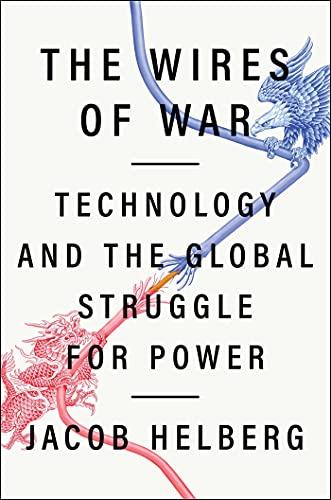

The book delves into technological warfare between the US and China, particularly in relation to Taiwan, which has been at the epicenter of the 'gray zone conflict'.
The book is all about a struggle for war and technology and specifically about the US and China.
— Episode: 10/11/21: Jobs Report Fail, Mass Shortag...
Episode: 10/11/21: Jobs Report Fail, Mass Shortages, Facebo...
The book delves into technological warfare between the US and China, particularly in relation to Taiwan, which has been at the epicenter of the 'gray zone conflict'.
The book is all about a struggle for war and technology and specifically about the US and China.
As I write in the book, war has always been a spectrum and it's you're not either in a total state of war or a total state of peace.
And one of the things that technology has done over the last few years is it's allowed state actors to wage war in the gray zone, which is a concept that military experts referred to to talk about attacks that don't quite rise the conventional threshold of war.
And with Taiwan you have a situation that has been at the epicenter of gray zone conflict and what I call the gray war.
And unfortunately we're now reaching a point where it could potentially turn into a hot war.
Episode: 10/11/21: Jobs Report Fail, Mass Shortages, Facebo...
The book discusses the use of technology in waging war in the gray zone, which refers to attacks that don't rise to the conventional threshold of war. It uses Taiwan as an example of how technology is pervasive and how it can lead to a potential hot war.
War has always been a spectrum, and it's you're not either in a total state of war or a total state of peace. And one of the things that technology has done over the last few years is it's allowed state actors to wage war in the gray zone, which is a concept that military experts referred to to talk about attacks that don't quite rise the conventional threshold of war. That has become a pervasive aspect of international politics because technology now infuses every aspect of our lives.
The South China Sea is a major corridor for infrastructure, submarine cables which carries the bulk of information that connects North America and the Indo-Pacific, allowing China to take control of that it would be a huge setback to American national security, to intellectual property, to the sovereignty of a lot of countries in that region for reasons that I detail in the book.
Obviously an enormous amount of supply of computer chips get made in fabs that are in Taiwan by TSMC, and as I explained in the book, allowing China to control that would jeopardize our access to chips and also the integrity of the chips themselves.
Meauretime trade route is another major issue, and the last is precedent, and this has been a very thorny topic in the foreign policy community, but setting the precedent of allowing China to annex a democratic country like Taiwan is a really, really bad precedent to set, that is basically giving Russia the green light to invade Ukraine, it's letting China know that it can basically move forward and annex other parts of its disputed territories like the Senkaku Islands, China has disputed territories with 17 countries.
So Xi Jinping has made his intention of unification very very clear, so then the question is, what do we do about it? Do we want Taiwan to... The two scenarios that we have to avoid a war is scenario number one, we just let him take the island, or scenario number two, we prevent him from taking the island in the first place, we prevent him from trying to carry out an attempt to invade the island in the first place.
Episode: 10/11/21: Jobs Report Fail, Mass Shortages, Facebo...
The book was described as being about the technological struggle for power between the US and China, specifically discussing the concept of "gray zone" conflict and the potential for war in Taiwan.
War has always been a spectrum, and it's you're not either in a total state of war or a total state of peace.
It's probably the most dire in our lifetimes. I don't think we've ever had a situation where we realistically face the scenario of an actual hot war between major powers that are nuclear powers nonetheless.
And the old saying that you're not...We are confronted in China with a pattern of behavior that is completely at variance with our own.
So if you want to live in a healthy prosperous, stable country for years to come, solving this problem seems to be one of the key things that you can do.
Xi Jinping has made his intention of unification very very clear. So then the question is, what do we do about it?