Podcast
Freakonomics Radio
The hosts repeatedly highlighted the new title, noting it was their third collaboration and that it encouraged readers to rethink problems, think like a child, and view failure as an ally. Dubner and Levitt promoted the launch with tours, a book‑club, and special offers, emphasizing its practical, how‑to style. They presented it as a key resource for listeners seeking fresh perspectives.
Episode: Think Like a Child (Rebroadcast)
The hosts discussed their third book together, 'Think Like a Freak', referencing a chapter specifically about thinking like a child and its potential to unlock new perspectives and solutions.
We've just published our third book together, Think Like a Freak.
So I'm going to give you a childish answer to that question, which is that my second favorite chapter in the book is to think like a child.
Episode: 192. That’s a Great Question!
It was mentioned in the context of a book tour that the authors, Stephen Levitt and Stephen Dubner, undertook to promote their book.
Last May, when Levitt and I published Think Like a Freak, we went on a long book tour, first in the US and the UK.
Episode: How Much Does Your Name Matter? (Rebroadcast)
It was mentioned as the title of a new book related to the Freakonomics Radio podcast, which was to be discussed in a live Twitter chat.
On Monday, August 4th, I will be doing a live Twitter chat with iBooks at 4pm Eastern Time, 1pm Pacific Time. I will answer your questions about our new book, Think Like a Freak, about Freakonomics Radio, any question you want to throw at me.
Episode: 174. What Do King Solomon and David Lee Roth Have...
It was mentioned as a book that uses the phrase "teaching your garden to weed itself" to describe the practice of using game theory to reveal information about people's actions.
In our book, Think Like a Freak, we give this practice a different name. We call it teaching your garden to weed itself.
Episode: 172. How to Screen Job Applicants, Act Your Age, a...
The book's central theme was explored, emphasizing the importance of thinking critically rather than relying on autopilot. The authors also discussed how the reluctance to admit ignorance hinders learning and encouraged redefining problems.
The most important idea in your new book was the underlying principle that to think like a freak, you must in fact think.
I love Glenn's question. I think this is super smart and really interesting and important. I think it's great.
I never would have thought this before I started working with companies. I never would have imagined that it is an IT problem.
I do love Glenn's question. I think this is super smart and really interesting and important. I think it's great.
So the minute you hear your name on this program, that means that you are going to get some think like a freak swag.
Episode: 171. There’s No Such Thing as a Free Appetizer
The first installment of a book club for 'Think Like a Freak' was announced to be in the next Freakonomics Radio episode.
Hey, podcast listeners on the next Freakonomics Radio, the first installment of our Think Like a Freak book club will answer your questions about the first three chapters.
Episode: 169. Failure Is Your Friend
It was mentioned as a new book where the authors argued that failure should be celebrated rather than stigmatized, with the idea that it can lead to more opportunities.
In our new book, Think Like a Freak, we make the argument that perhaps we are not thinking clearly about failure. Maybe failure can be your friend.
Episode: The Upside of Quitting (Rebroadcast )
The podcast mentioned it was inspired to write a chapter about quitting in their new book, Think Like a Freak.
We heard from a lot of listeners who told us that this episode inspired them to quit something and inspired us to write a chapter about quitting in our new book, Think Like a Freak.
Episode: 168. Think Like a Child
It was mentioned as the third book published by Stephen Dubner and Steve Levitt together, with a chapter specifically discussing the benefits of thinking like a child in various fields.
We've just published our third book together, Think Like a Freak.
So I'm going to give you a childish answer to that question, which is that my second favorite chapter in the book is to think like a child.
And I think that the beauty of thinking like a child and the beauty of that chapter in our book is that sometimes doing things differently and simply and with a kind of joy and triviality leads you to a really special place.
Episode: 165. The Perfect Crime
The Freakonomics Radio hosts' new book, 'Think Like a Freak', was mentioned, along with a CBS Sunday Morning segment about it that was scheduled to air on May 4th.
Hey, podcast listeners, as you may have heard, our new book, Think Like a Freak is out on May 12th.
On May 4th, the CBS show Sunday Morning is scheduled to run a segment on us and the book.
Episode: 164. Which Came First, the Chicken or the Avocado?
The book 'Think Like a Freak' was mentioned and promoted with a free signed bookplate offer. It was discussed in relation to the podcast and its core themes, including the concept of selective outrage.
Hey podcast listeners, our new book, Think Like a Freak is out on May 12th. You can visit Freakonomics.com to learn more or pre-order a copy or 100 copies if you need them.
And happy news here, we are bringing back our free signed bookplate offer.
Which means you can turn a regular old copy of Think Like a Freak into a snazzy autographed copy.
Episode: 163. What’s More Dangerous: Marijuana or Alcohol?
It was mentioned as a new book being published on May 12th and listeners were encouraged to call in sick to read it.
Hey podcast listeners, don't forget our new book Think Like a Freak will be published on May 12th.
So if you think you need to set aside a little time on that day for some light reading, maybe you want to go ahead and call in sick right now just to get it out of the way.
Episode: 162. “If Mayors Ruled the World”
It was mentioned as being published on May 12th in hardcover, ebook, audiobook, and large print formats. Preorders allowed listeners to receive the first chapter.
Hey podcast listeners, our new book, Think Like a Freak, will be published on May 12th as a hardcover ebook, audiobook, large print edition, you name it.
And if you preorder it in any format from any store, you can get the first chapter now delivered to your email inbox.
Remember our new book, Think Like a Freak is out on May 12th.
If you preorder it in any format from any bookstore, you can get the first chapter now.
Episode: 161. How to Make People Quit Smoking
It was described as a 'how-to' book, attempting a different style than their previous works, and was announced with upcoming book tours, a book club, and podcast episodes based on it.
The date? May 13th. Okay. The title of the book? Think Like a Freak.
But then we had this idea to do something that's more like a, almost like a how-to book, how to think like a freak.
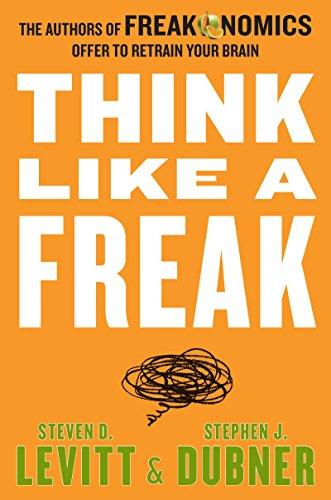
The full title is Think Like a Freak. The authors of Freakonomics offer to retrain your brain.
We are starting a Think Like a Freak book club right here on the podcast.
Hey, podcast listeners, as we mentioned at the top of the show, Levitt and I are putting out a new book called Think Like a Freak on May 13th.