Podcast
Behind the Bastards
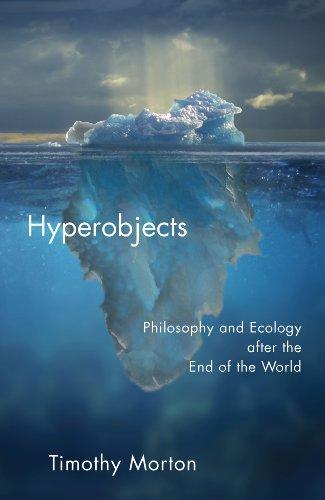
Timothy Morton's book, "Hyperobjects", was quoted when discussing climate change as a hyperobject. It described the difficulty in perceiving hyperobjects in their totality, citing the example of raindrops versus global climate.
Consider raindrops. You can feel them on your head, but you can't perceive the actual raindrop in itself. You can only ever perceive your particular anthropomorphic translation of the raindrops. Isn't...
— Episode: It Could Happen Here Weekly 18
Episode: It Could Happen Here Weekly 18
Timothy Morton's book, "Hyperobjects", was quoted when discussing climate change as a hyperobject. It described the difficulty in perceiving hyperobjects in their totality, citing the example of raindrops versus global climate.
Consider raindrops. You can feel them on your head, but you can't perceive the actual raindrop in itself. You can only ever perceive your particular anthropomorphic translation of the raindrops. Isn't this similar to the rift between weather, which I can feel falling on my head, and global climate? Not the older idea of local patterns of weather, but the entire system. I can think of and compute climate in this sense, but I can't directly see or touch it. The gap between the phenomenon and the thing yawns wide open, disturbing my sense of presence and being in the world.
...light itself is the most viscous thing of all, since nothing can surpass its speed.
This is it, folks! This is the ecological interconnectedness! Come in and join the fun! But I see that you're already here. Unquote.